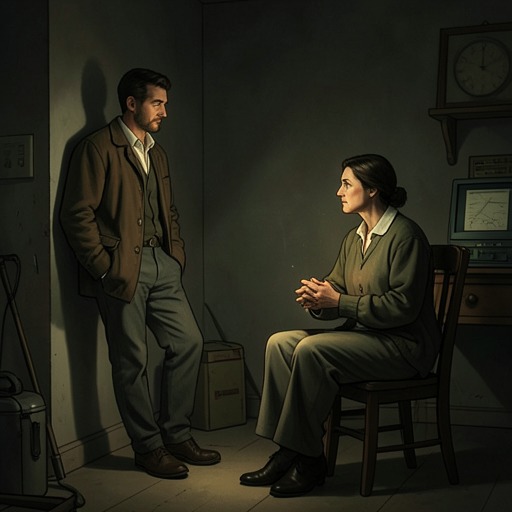
Suicide attempt of Françoise Mer
Les Choses humainesFrançoise Merle’s suicide attempt is the crisis that makes Jean Farel confront, without being able to undo, the damage caused by his treatment of her. The news reaches him during his Élysée Palace decoration ceremony, at the height of his public triumph; his hurried visit to Françoise in hospital ends not in reconciliation but in her demand that he leave and take responsibility for Claude, the dog he gave her. Her attempt marks a rupture in their relationship and exposes the distance between Jean’s professional courage and his private conduct.
News at the Élysée
Jean learns of Françoise’s attempt by text message while guests are gathered for his ceremony at the Élysée Palace. The contrast is immediate: around him, the rituals of public recognition continue, but his attention is captured by the possibility that Françoise may die. He imagines collapsing in front of the assembled guests and being photographed in disgrace. When another message says that she is in psychiatry at Bichat Hospital, he still cannot leave. The President is arriving, and the ceremony in Jean’s honor is about to begin.
The news also changes how Jean understands their recent confrontation. He regrets having been too harsh and thinks that Françoise attempted suicide because of him; he tells himself that he loves her. Yet even in this moment of alarm, his attention keeps returning to the demands of public performance: he cannot make the President wait, and he believes he must play his part at the ceremony and the reception. The crisis is not simply set against his achievement; it unfolds inside the very occasion that publicly confirms his status.
Jean’s ceremony also coincides with other signs that his public image is precarious. After it ends, he posts a photograph on Twitter with a misspelled reference to the Legion of Honor, writing “Légion d’horreur” instead of “Légion d’honneur.” Mockery spreads online, and he deletes the post, though screenshots continue to circulate. He then takes a taxi to Bichat, carrying the bouquet the President gave him. The bouquet, left behind by Claire after she goes to join Adam, becomes an offering for Françoise, who had once dreamed of receiving one.
The hospital visit
Jean reaches the psychiatric ward despite the late hour and the end of visiting time. A smile and an autograph persuade staff to let him in, a small instance of celebrity granting him access that ordinary visitors would not have. An nurse warns him not to tire Françoise, who is very weak. In the small, dark, overheated room, she lies under a white sheet, her hands marked with brown spots; Jean finds her looking gravely altered and kisses her forehead. The scene’s care and intimacy do not restore their former closeness. Françoise answers his concern with a dry remark that she failed in her attempt.
Jean asks what drove her to it, but Françoise does not answer. The narrative sets her silence against the life she had built around freedom and independence: she knew she needed to leave him for the sake of her mental and physical survival and had already been pushed beyond her limits. Jean takes her hand and apologizes, calling himself brutal and stupid and saying that he loves her. Françoise turns her face away. His apology acknowledges his behavior, but it cannot substitute for the separation she has decided is necessary.
Courage and private conduct
When Jean presses Françoise to say something, she answers by distinguishing his public bravery from his private life. She recognizes that he took professional risks and placed himself at the center of the country’s political life; she says that she admired him for that. But, in her judgment, he showed no courage in private. Her accusation punctures the identity celebrated at the Élysée: the ceremony’s honor cannot settle the question of how Jean has treated the people closest to him.
Jean partly concedes the charge, saying that he was too absorbed in his work and that he deserves what he has received. But the narration also records his inward resistance: he thinks of her criticism as conventional psychology and reflects that adultery’s illicitness was part of what made it exciting to him. The gap between apology and recognition remains. He can express regret and desire, yet still frames their relationship through his own justification and does not show that he has understood the cost Françoise describes.
Separation and its consequences
Jean moves closer as if to kiss Françoise, but she draws back. In a flat voice, she tells him to go and not return. He is stunned for a few seconds, then agrees. The farewell is both an immediate boundary and a decisive break: Françoise does not ask him to comfort her or resume their relationship. She asks for practical help instead, telling him to look after Claude and fetch the dog. She calls Jean’s gift of Claude the best thing he ever did for her, then rejects any further offer of assistance.
Jean believes the attempt will also end Françoise’s journalism career. He anticipates sick leave and eventual dismissal, and thinks that he will not be able to save her from that outcome. This forecast is presented through his anxious perspective, not as a confirmed later resolution. What the visit does confirm is the changed balance between them: Françoise has made leaving him a condition of survival, and Jean leaves without having persuaded her to stay.
Narrative significance
The attempt recurs in the novel as an interruption of Jean’s public self-presentation. At the Élysée, he is being celebrated as an eminent journalist; at Bichat, he encounters a weakened Françoise who refuses to let his fame or remorse define what she needs. His brief use of celebrity to enter the hospital contrasts with the limits of that privilege once he is at her bedside. He can secure access, but he cannot command forgiveness or intimacy.
The episode also places the costs of Jean’s controlling, self-absorbed conduct in the intimate sphere alongside the scrutiny he faces elsewhere. After the news that Alexandre has been taken into custody on suspicion of rape becomes public, Jean’s attention turns to the threat to his own reputation and to the family name. Against that wider pressure, Françoise’s attempt and refusal to return remain a separate personal consequence: a crisis Jean cannot convert into a public-relations problem and resolve by managing appearances. The scene ends not with rescue or reconciliation, but with a concrete obligation—to care for Claude—and a relationship Françoise has told him to leave behind.